
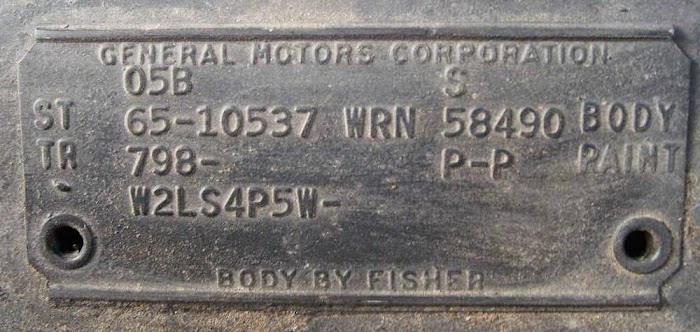
One feature that seems to set Corvair owners apart from other Classic Car hobbyists is our fascination (obsession?) with body tags.
If you are new to Corvairs and bumping around on the forums or Facebook Groups, you may see new(er) owners asking about tag “decoding” help or debates on whether a body tag has been swapped, missing or flat out wrong with regards to the car it’s attached to.
This is an extensive topic, and we like to keep these posts somewhat brief, so we will have links at the end of this article where you can do a deeper dive into tag decoding. To give you a primer on how to decode your tag, we will use the tag above as an example and the guide below to walk us through.
Here are the basics…

When your Corvair was on the assembly line, it had unique features assigned to it when it was being built. Body style, trim style, color(s), interior and accessories were all laid out on these raised letter metal tags. Your Corvairs birthday, birthplace (factory) and sequence number is also included.
Every year had different accessories available to the Corvair. Some options were dropped off after a couple of years, some new options picked up.
~Fun fact: seatbelts were an “option” in early Corvairs. By 1966, all Corvairs coming off the line had seatbelts installed with federal law making seatbelts mandatory 1968.~
Years and years have been spent by Corvair sleuths to decode and catalog Corvair body tags. We thank these folks for their dedication to this project.
Body build date
The first set of characters you see are a three character code on the top left corner of the bodytag. This represents the date code. The code consists of two digits and a letter*. The digits represent the month, and the letter represents the week. This code represents the date the body was completed by Fisher body. The body would then be delivered to the Chevy side to install the drivetrain and complete the car.
*The car in our sample tag was built on the 2nd week of May (5B)
STYLE
Next in line is style, which list first the year and then model of the Corvair.
(i.e. 63-0967 means 1963 Monza Convertible or 65-10567 for 1965 Monza Convertible)
*The car in our sample tag is 65-10537 which is a Monza hardtop coupe
BODY
This line lists the plant code* and body number. The body number represents the number of that body style built. (i.e. if the car is a Monza convertible, then the body number represents the number of only Monza convertibles built, it would not include Corsa convertibles or Monza coupes or sedans.)
The body number is specific and linked to the style number. So for example in 1965 there were 7 different styles and each style had its own series of body numbers for that plant.
*The car in our sample tag was the 58490 Monza Coupe off the line at the Willow Run plant in 1965
Plant codes on the body tag include:
1960 plants: OA = Oakland, KC = Kansas City, WR = Willow Run (Detroit)
1961 plants: OA = Oakland, WR = Willow Run
1962 plants: OA = Oakland, WR = Willow Run
1963 plants: OA = Oakland, VN = Van Nuys, WR = Willow Run
1964 plants: WR = Willow Run (no other plants that year)
1965 plants: WRN = Willow Run, LOS = Los Angeles (Van Nuys) *the car in our sample tag was built in WRN in 1965
1966 plants: WRN = Willow Run, LOS = Los Angeles (Van Nuys)
1967-69 plant: WRN = Willow Run (no other plants these years)
*note there were cars produced for Canada and overseas markets, but we are only listing US plants here*
TRIM
This 3 digit codes represents the interior upholstery color and seat type. An extra digit is include for 1963-64 convertibles for the top color. On 1966-67 models the extra digit denotes whether the car has optional headrests or not.
*The car in our sample had TR 798 Ivory (white) interior. This was the vinyl used on the seats and door cards. Padded dash and carpet were likely black.
PAINT
Exterior: 1960 through 1964 Corvairs use a three digit exterior paint code. Late models (65-68) have a different paint code. They used a two character code employing two letters for hardtops and a one letter/one digit code for convertibles.
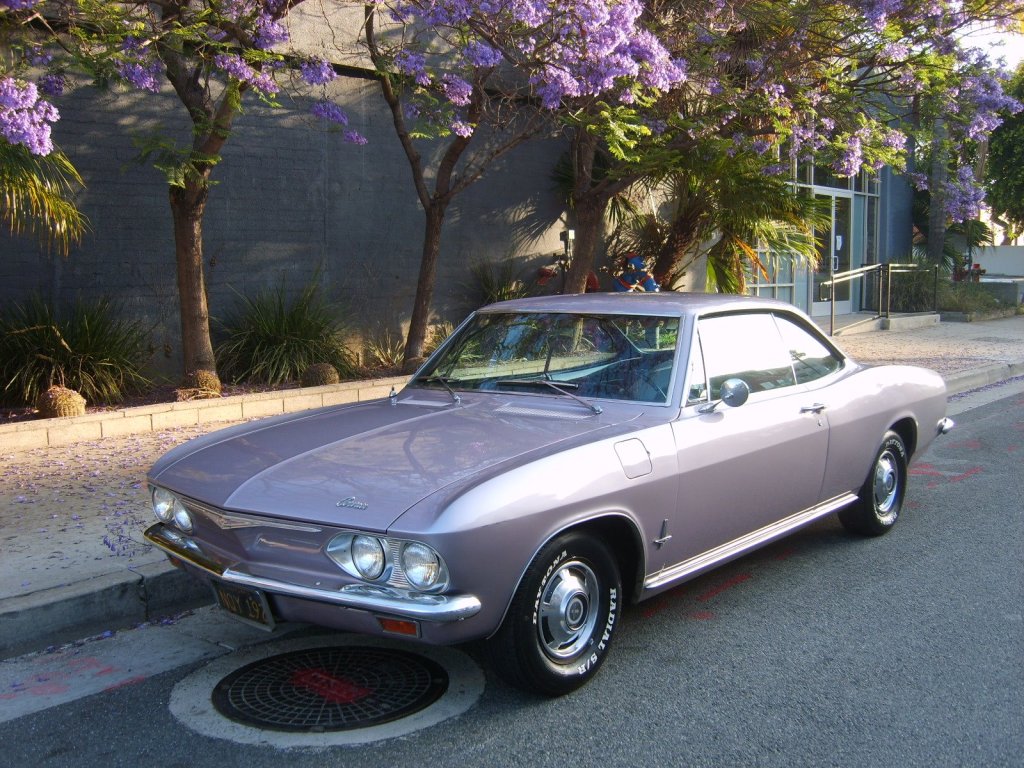
*The car in our sample has paint code P-P which was Evening Orchid. This was a one year only paint color and highly desirable today.
ACC = Accessory line
When decoding ACC line on the Fisher bodytags, be aware that body tags do not include any options that did not require any body modification be done by Fisher. Fisher was only concerned with items that required modifications during the assembly of the body.
A good example is that you won’t find Telescopic column listed on the body tag. Although this is a major option, it did not require any special consideration during body assembly.
Fisher body tags ACC line
This the code of letters at the bottom of the tag denoting which options were put on the Corvair at the assembly plant. Things like tinted glass, radio, day/night rearview mirror, rear mounted antenna, etc. To this day, there are still mysterious accessory numbers that have not been decoded. The links at the end of this article will allow you to take a deep dive on the accessories provided to your Corvair.
*The car in our sample tag had the accessories W2LS4P5W
W – Tinted windshield
2 notes 2nd group of options
L – 4speed transmission
S – Rear mounted antenna
4 notes 4th group of options
P – convenience group ( 2 speed wipers, washers, day/night inside mirror)
5 notes 5th group of options
W – Deluxe Seatbelts (Chrome Buckles)
Ok sleuths! You know the assignment!
Time to go decode those body tags and let us know how accurate your Corvair is today from the day it was built.
~ Corvair Gold provided by the Stock Corvair Group
~ Production Options and stats from the Corvair Kid (Kent Sullivan)
~Paint chip example reference (and where to get factory match paint!)
~ The Corvair Decade Book by Tony Fiore

 SFBA CORSA
Leave a comment